
Introduction
Search ‘best business e-wallet Philippines’ and most comparisons default to cashback rates, app store ratings, and screenshots of a clean interface. Those factors matter less than they seem to once real money is moving through the account. A business e-wallet carries a different set of stakes than a personal one, since customer funds, payroll timing, and vendor payments all depend on it working correctly every single day. This article breaks down what should actually make the shortlist, starting with regulatory trust and ending with how fast your money moves after a sale closes. A genuine best business e-wallet in the Philippines is judged less by its interface and more by what stands behind it.
Why BSP Supervision Should Be the First Filter, Not the Last
The single most important shortlist criterion for any business wallet is often the last one owners check, if they check it at all. A provider directly supervised by the Bangko Sentral ng Pilipinas as a licensed Electronic Money Issuer answers to a regulator that reviews how customer funds are held, moved, and reported on an ongoing basis rather than only at sign-up. That is meaningfully different from a wallet operating under a partner bank’s license without carrying its own.
BSP supervision requires capital adequacy, reporting discipline, and consumer protection standards that a business owner cannot verify simply by reading an app description. It is, however, easy to ask directly: Is this provider a BSP-licensed Electronic Money Issuer, or does it operate under someone else’s license? For an online digital wallet built for business use, that single answer often tells you more than every other feature on the list combined.
The Credibility Benchmark That Separates a Serious Business E-Wallet From a Consumer One
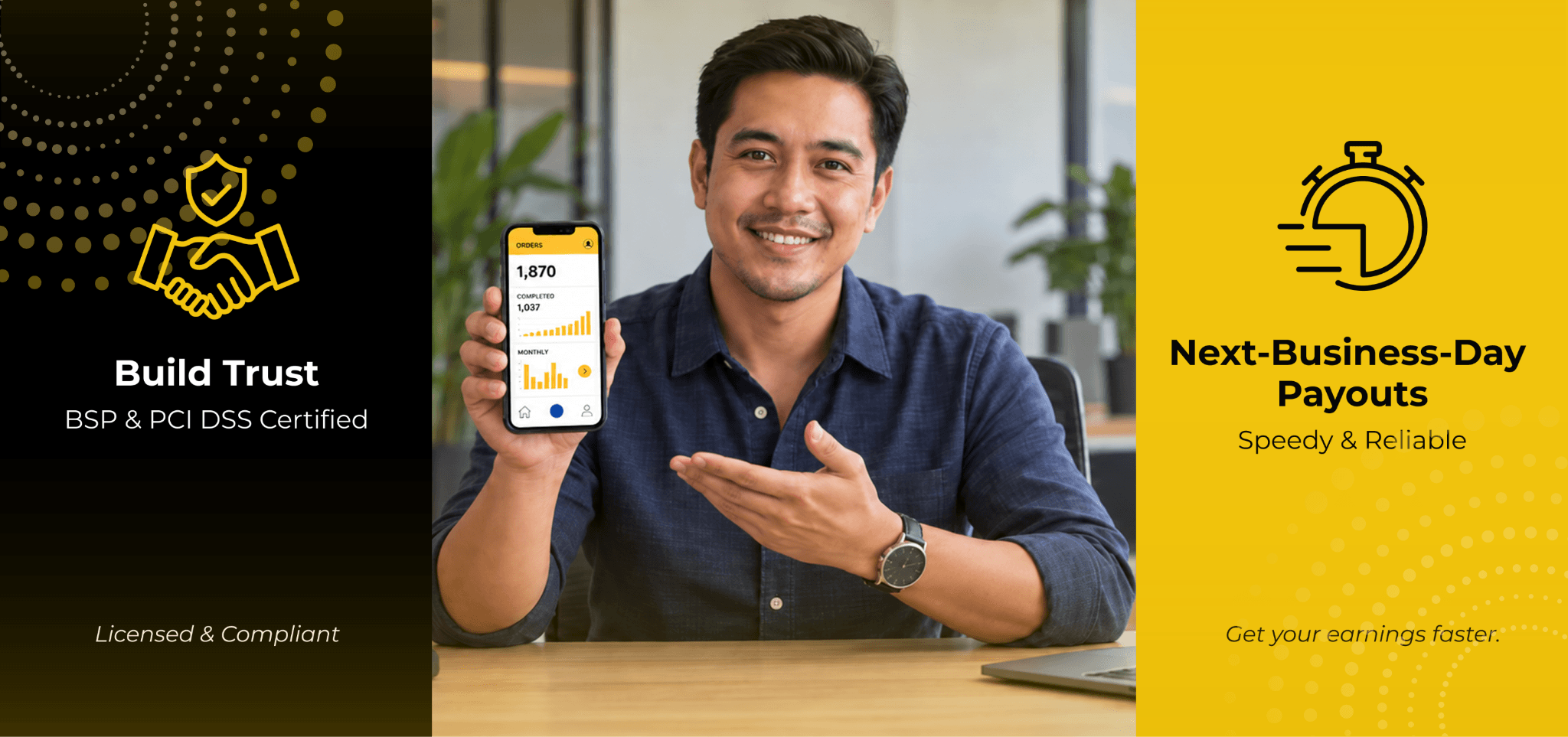
A consumer chat app wallet and a genuine business e-wallet can look similar on a phone screen while running on entirely different infrastructure underneath. PCI DSS v4.0 certification is the current global benchmark for how card data is protected, and it covers tokenization, encryption, and access controls that go well beyond what a personal wallet needs to implement. This distinction matters most when a business is collecting payments from institutions that require documented compliance from their vendors, including government agencies, schools, insurers, and real estate developers. A digital mobile wallet used for business should be able to produce current certification documentation on request, not just display a badge on a website. That documentation is the credibility benchmark a consumer wallet was never built to provide, and it is what lets a small business answer a customer’s security question with evidence instead of reassurance.
Fast, Reliable Payouts: The Shortlist Test Most Comparisons Skip
A business e-wallet that accepts payments quickly but settles slowly still leaves the business waiting on its own money, and this gap rarely shows up in feature comparisons. The practical difference between a T+1 next business day payout and a slower T+3 or batch settlement cycle compounds quickly for any business managing supplier payments or payroll on a tight schedule.
This is the shortlist test worth applying to a best business e-wallet Philippines candidate before signing anything, and it should be verified directly with the provider rather than assumed. A business can see exactly how a payment moves from acceptance to settlement, closing the visibility gap that generic comparisons tend to skip entirely through a secure digital business wallet. Payout speed deserves the same scrutiny as payment acceptance, because a wallet is only as useful to a business as the speed at which collected revenue turns back into usable capital.
Channel Breadth as a Trust Signal: Why 50+ Payment Options Says More Than Marketing Copy
The number and range of supported payment channels, cards, e-wallets, bank transfers, and over-the-counter options, say more about a provider’s scale than a feature list usually implies. Supporting more than 50 channels under one BSP-supervised entity is not simply a convenience add-on. It reflects the institutional relationships and infrastructure investment needed to integrate that many payment rails reliably.
A business e-wallet that consolidates acceptance, payouts, and wallet functionality in a single ecosystem also reduces how many separate vendors a business has to individually vet, contract, and trust. Every additional standalone provider is another party with access to transaction data and another point of potential failure. Channel breadth, seen this way, functions less like marketing copy and more like a proxy for how much operational weight a provider can actually carry.
5 Questions to Ask Before You Shortlist a Business E-Wallet
1. Is the provider a licensed Electronic Money Issuer (EMI), directly supervised by the BSP, or does it ride on a partner bank’s license?
A duly licensed EMI provider should have a BSP Certificate of Authority or Certificate of Registration as an EMI in the provider’s own legal name, with the license number verifiable against the BSP’s published list of licensed institutions.
2. Is the provider certified to PCI DSS v4.0 and can they show current documentation?
A certified Business Wallet provider should be able to present a current Attestation of Compliance (AOC) that is dated within the last 12 months; the Self-Assessment Questionnaire, if applicable; and a scope statement confirming which systems and services are covered, ideally including the platform and APIs you’ll be using.
3. What is the standard payout timeline for domestic transactions?
A domestic standard payout timeline should include a contractual timeline with specific calendar or business days for clarity. It is “T+1 for wallet and QR, T+2 for card. A given time should be provided for when the clock starts for transactions vs. batch cutoff, and whether weekends and holidays delay settlement.
4. How many payment channels are supported out of the box, and do they include what your customers actually use?
A customer should have access to a named channel list to check against their own transaction data, with success-rate or uptime figures for the top channels. A weak answer is a long list with no overlap with how your customers actually pay, or refusal to disclose routing.
5. Is transaction and settlement data visible in a real-time dashboard or only in periodic statements?
Clients should have 24/7 access to a live dashboard with transaction-level detail, settlement status, fee breakdown, exportable data (CSV/API), and the ability to filter by date, channel, and status, plus API access to automate reconciliation. Ask to see a demo with real data before committing, and ask how quickly adjustments and reversals appear.
Checkout Solutions by Paynamics May Be Your Best Business Decision
Paynamics answers each of these questions directly, as a BSP-supervised Electronic Money Issuer, PCI DSS v4.0 certified, serving more than 5,000 merchants across over 50 payment channels. Real-time reconciliation on the transactions dashboard and T+1 payout automation come built-in, not offered as a separate add-on tier. For a business comparing solutions against this exact checklist, Paynamics is built to answer every question on it with documentation rather than promises, which is what actually separates a shortlist-worthy provider from the rest of the field.
Conclusion
The best business e-wallet in the Philippines for a small or mid-sized business is rarely the one with the most polished interface. It is the one that is verifiably supervised by the BSP, certified to PCI DSS v4.0, and fast enough with payouts that collected revenue becomes usable capital by the next business day.
Before adding any provider to a shortlist, ask the five questions above and expect documented answers, not marketing language. The Paynamics Business Wallet built on that foundation is worth exploring further, starting with what it can do for your own payment operations.