Introduction
Every biller in the Philippines runs on collections. From government agencies to small private enterprises where payments come in daily through banks, e-wallets, and over-the-counter channels, finance teams still spend hours each week matching every transaction by hand. At the same time, funds already collected often sit for two, three, even five days before they can actually be used. Digital payments solved how customers pay. They did not solve how billers get paid, reconcile that money, and put it to work.
This is the gap that separates ordinary digital tools from a true fintech payment platform service provider. This article looks at why manual reconciliation and slow fund turnaround are now the two biggest operational drags on billing and collections, and how Paynamics closes both gaps with a real-time dashboard and automated T+1 payouts.
The Two Operational Gaps Government and Enterprise Billers Can No Longer Ignore
Most billers already accept digital payments. The real problem shows up after the payment is made, in the back office work that turns a transaction into usable, accounted-for cash.
1. Manual Reconciliation
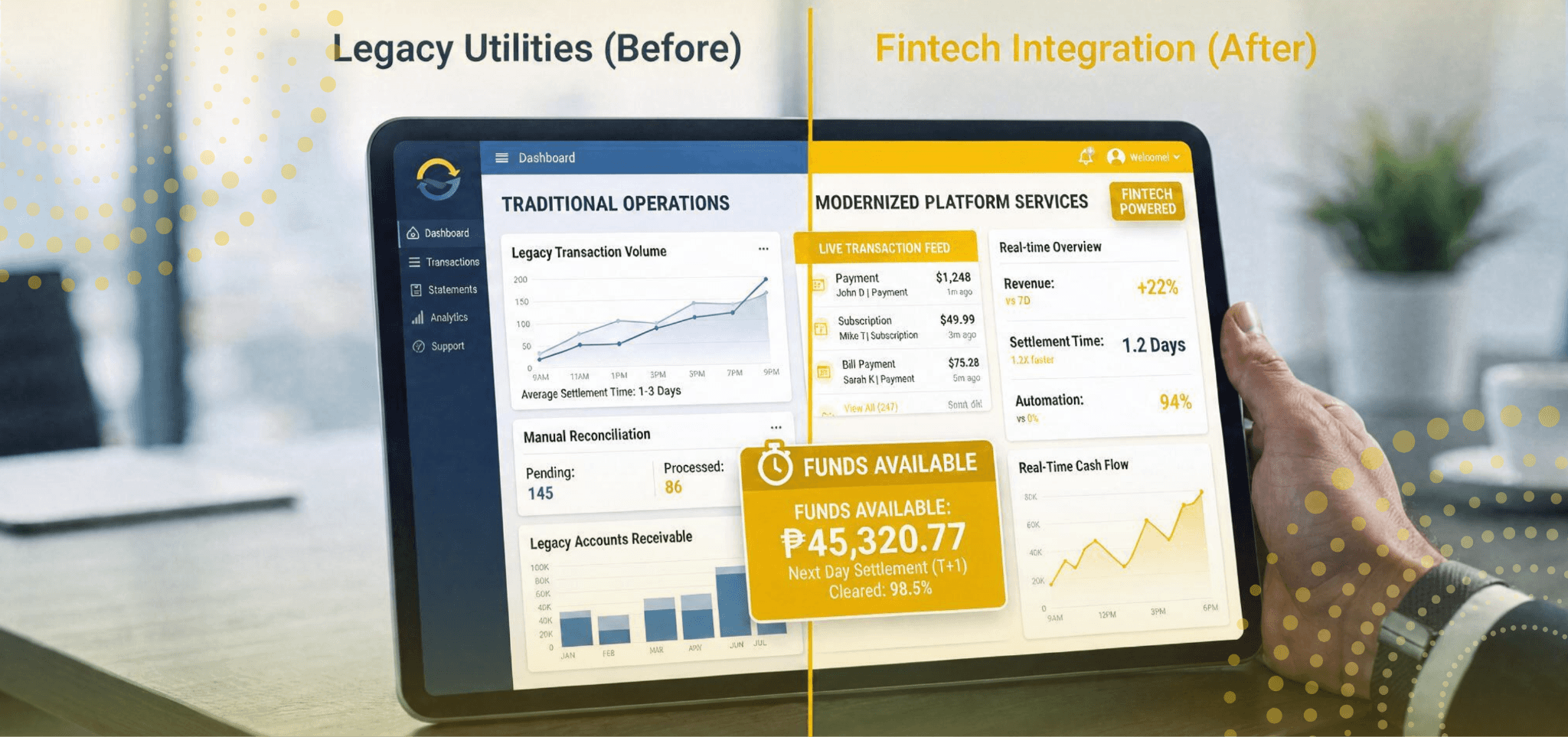
Every payment channel, bank, e-wallet, and OTC network sends its own settlement file, in its own format, on its own schedule. Finance staff spend days matching these files line by line against billing records, and the work multiplies with every new channel added. As transaction volume grows, this task stops being a minor inconvenience and becomes a genuine bottleneck that delays reporting and hides errors.
2. Slow Fund Turnaround
Collected money is not usable money until it clears into the biller account. When settlement takes several business days across fragmented channels, billers cannot pay suppliers, fund operations, or plan cash flow with any certainty. Combined with manual reconciliation, this turns two back office issues into a real constraint on the business.
What a Modern Fintech Payment Platform Should Bring to the Table
Before trusting any of the many fintech payment companies operating in the Philippines with essential service collections, billers should expect certain baseline standards, not just a payment button on a website.
BSP Supervision
A provider should operate under the oversight of the Bangko Sentral ng Pilipinas, which sets the rules for how payment systems in the country are run and protected.
Electronic Money Issuer Status
An Electronic Money Issuer (EMI) license means a provider meets specific liquidity, capital, and reporting requirements set for institutions that hold and move customer funds. Paynamics operates as a BSP-supervised entity and Electronic Money Issuer, which gives billers a regulatory layer of protection that informal payment tools cannot offer.
PCI DSS v4.0 Certification
Card data security is not optional for a company handling essential service payments. PCI DSS v4.0 certification confirms that a provider meets the current global standard for protecting cardholder data across every transaction it processes.
Proven Scale
A platform worth switching to should already be doing this at scale. Paynamics supports more than 5,000 merchants across 50 or more payment channels, spanning payment acceptance, payouts, and its own wallet ecosystem, with experience serving both enterprise and government clients.
The Consolidated Dashboard: Reconciliation Without a Dedicated Back Office
A consolidated fintech payment platform reduces the complexity of stitching together multiple point solutions, giving billers a clearer and more efficient way to manage reconciliation.
Who benefits from this:
- Small billers: Manual reconciliation can quickly overwhelm a finance team of one or two people.
- Government agencies: Reconciliation delays create more than inefficiency, they can become transparency and audit issues.
- High-volume enterprises: Managing payments across multiple channels means more spreadsheets, cross-checks, and opportunities for errors.
What you get from this:
- A fintech payment platform: consolidates transactions from banks, e-wallets, and OTC channels into a single, continuously updated dashboard.
- Less manual work: Finance teams get a complete view of payments without compiling separate settlement files.
- Audit-ready visibility: Transactions can be searched by channel and pulled into reports without additional preparation.
T+1 Payout Automation: Cash Flow Certainty for Billers
Not every biller has a treasury team managing disbursement schedules. For many organizations, especially lean finance teams, predictable access to collect funds is essential to keeping daily operations running smoothly. Automated payouts reduce reliance on manual batch processing and help create a more dependable disbursement schedule
Here is how next business day payouts help different types of billers:
- Small billers and essential service providers: Lean finance teams often work with limited cash buffers. Delays in accessing collected funds can quickly affect:
- Supplier payments
- Payroll schedules
- Day-to-day operating expenses
- Other time-sensitive financial commitments
- Government agencies: Government agencies need public fund disbursements to be:
- Predictable
- Auditable
- Consistent
- Large private enterprises: Businesses managing multiple billing channels need these to support their organization:
- Consistent payout timing
- Predictable schedule
- Dependable disbursement schedule
Automated T+1 payout processing removes much of the uncertainty from fund availability. Funds collected across connected channels are deposited into the biller account on the next business day, without an additional manual disbursement step that can introduce delays or human error.
This is an important part of what a fintech payment platform service provider should deliver. The value is not limited to providing a record of collected payments. It also means giving billers a clear and reliable timeline for when those funds become usable.
5 Signs Your Current Payment Setup Is Costing You Time and Money
A few warning signs tend to show up well before billers realize their payment setup has become a liability.
1. Slow Manual Data Entry
Staff retyping or copy-pasting transaction data between systems is time that could go toward actual finance work.
2. Delayed Visibility Into Daily Collections
If yesterday’s collections are not visible until tomorrow or later, decisions are always made on outdated numbers.
3. Unpredictable Fund Turnaround
Not knowing exactly when collected money clears into your account makes cash flow planning a guessing game.
4. High Processing Fees
Fragmented setups spread across multiple providers often mean paying several sets of fees for the same volume of transactions.
5. No Mobile Options
Customers increasingly expect to pay through mobile channels, and a setup without that option quietly loses collections.
Paynamics Custom Finance Solutions: The Fintech Platform Built to Close Operational Gaps
Paynamics was not built as a patchwork of point solutions. It was built to close the two gaps billers feel most: visibility and speed. The PTI dashboard consolidates transactions from every connected payment channel into one real-time view, replacing manual matching with an always current record. Automated T+1 payout processing then moves those collected funds into the biller account the next business day, without extra manual steps.
For billers without the resources for a full API integration, or without their own website, Paynamics also offers readily available payment pages through Paynamics Checkout, so schools, insurance providers, real estate developers, retailers, and travel operators can start collecting without building anything from scratch. This is what makes Paynamics a fintech payment gateway that billers can rely on across sectors, not just for utilities.
Conclusion
Government and enterprise billers cannot keep treating manual reconciliation and slow fund turnaround as background noise. Together, they cost time, obscure cash positions, and quietly limit growth. A fintech payment platform service provider built around real-time visibility and automated payout turns both pain points into an advantage instead of a liability.
Paynamics already does this today, for small billers as well as for education, insurance, real estate, retail, and travel businesses across the Philippines. Talk to the Paynamics team about moving your billing operations onto a platform that shows you exactly how your money gets to you, faster.