
Introduction
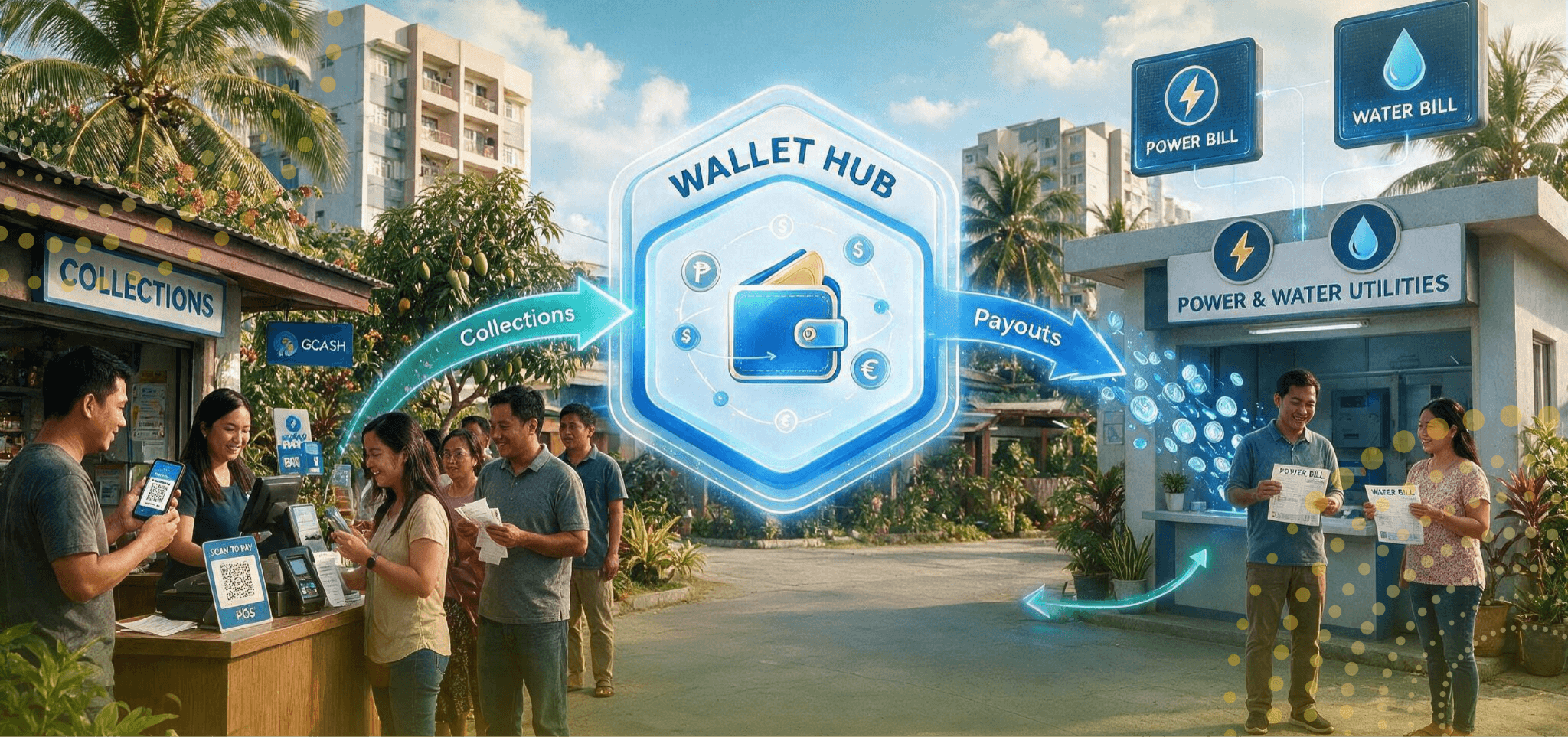
Legacy billing systems for government and private enterprises were built to do one thing: accept a payment. But running collections at scale also means disbursing agent commissions, processing refunds, and settling with suppliers, usually through a completely separate set of tools that has nothing to do with the collections system. Two disconnected systems mean two support relationships, two reconciliation processes, and two places where money can get stuck between collected and settled.
Merchant payment processing services in the Philippines double down on both sides of the ledger: payment acceptance, payouts, and a business wallet under one provider relationship. This article looks at what utility merchants actually need beyond basic acceptance, why payouts are the overlooked half of merchant services, and what a true business wallet ecosystem makes possible.
How do Merchant Services Work?
Every time a customer taps, swipes, inserts, or enters their card details online, a series of secure processes happens behind the scenes in just a few seconds. Merchant services make that entire payment journey possible from authorization to depositing funds into your account.
Here’s what happens during a typical card transaction:
1. Customer Makes a Payment
The process begins when a customer pays using a credit card, debit card, or digital wallet. Your point-of-sale (POS) system or online payment gateway securely captures the payment information and sends it to the appropriate card network for verification.
2. Transaction is Verified
The card network communicates with the customer’s issuing bank to confirm that the payment is legitimate and that sufficient funds or credit are available. Within seconds, the transaction is either approved or declined, and the response is sent back to your payment system.
3. Payment is Authorized
Once approved, the sale is completed, allowing the customer to leave with their purchase. At this stage, however, the funds haven’t been transferred yet. Instead, your business receives an authorization confirming that the payment has been approved.
4. Payment Processor Handles the Transaction
Your payment processor collects the approved transaction details and forwards them through the card network to the customer’s issuing bank. This step initiates the settlement process.
5. Funds are Deposited Into Your Account
The issuing bank transfers the payment through the appropriate financial channels, and the funds are deposited into your merchant account, typically within one to two business days. At the same time, the transaction appears on the customer’s card statement.
Though transactions feel instant to customers, they’re powered by financial institutions working together behind the scenes—with merchant service providers supplying the hardware, processing payments, detecting fraud, and enabling secure multi-payment acceptance.
Beyond Payment Acceptance: What Businesses Actually Need from a Merchant Service Provider
A front-end payment processor answers a narrow question: did the transaction go through? Merchants running collections at scale need a broader set of financial operations working together, from acceptance to settlement to dispute handling. Ordinary merchants increasingly expect one provider to handle the full transaction lifecycle rather than stitching together a payment gateway, a separate payouts vendor, and a manual spreadsheet for reconciliation. Merchant services built around this fuller scope save billers from maintaining three vendor relationships to do what should be one.
Merchant services combine several tools and technologies to help businesses accept, process, and manage electronic payments. Each component has a unique role in ensuring transactions are fast, secure, and reliable.
1. Point-of-Sale (POS) Systems
A POS system is the primary tool businesses use to process in-person payments. Beyond accepting payments, modern POS systems also help manage day-to-day operations.
Key features include:
- Accepts credit cards, debit cards, and digital wallet payments
- Sends transaction data securely for payment processing
- Tracks inventory in real time
- Records sales and generates reports
- Monitors customer and employee activity
- Integrates with accounting software for easier bookkeeping
2. Card Readers
Card readers are the physical devices customers use to complete a payment. They securely capture payment information and support multiple payment methods.
Common payment methods supported:
- Magnetic stripe (swipe) cards
- EMV chip (insert) cards
- Contactless “tap-to-pay” cards
- Mobile wallets such as Apple Pay and Google Pay using NFC technology
Benefits:
- Faster checkout experience
- Secure payment processing
- Greater flexibility for customers
3. Payment Gateways
A payment gateway is the online version of a POS system. It securely processes payments made through websites, mobile apps, and e-commerce stores.
What a payment gateway does:
- Encrypts customer payment information
- Sends transaction data for authorization
- Verifies card details before approval
- Helps reduce fraud with security measures, including CVV verification
- Enables secure online payments 24/7
4. Online Transaction Processing (OLTP)
Online Transaction Processing (OLTP) systems handle large volumes of transactions in real time while keeping accurate business records.
OLTP systems help businesses:
- Process payments instantly
- Record every transaction automatically
- Support accounting and financial reporting
- Maintain accurate sales records
- Deliver a fast and reliable checkout experience for online customers
Why These Components Matter
Each of these technologies works together to create a seamless payment experience. Whether you’re running a physical storefront, an online business, or both, merchant services provide the tools needed to:
- Accept payments securely
- Process transactions quickly
- Protect customer data
- Track business performance
- Simplify financial management
- Improve the overall customer experience
Payouts and Disbursements: The Overlooked Half of Merchant Services
Collections get most of the attention, but the outbound side of a merchant’s operations such as commissions, refunds, and supplier payments, creates just as many reconciliation headaches when it’s treated as an afterthought bolted onto a separate system.
-
Agent Commissions
Field agents and collection partners who process payments on a utility’s behalf need timely, traceable commission payouts, and delays here directly affect agent retention and service coverage in areas that depend on them.
-
Refunds
Overpayments, billing corrections, and service disputes all require refunds that customers expect to see quickly, and a payouts process disconnected from collections tends to turn a routine refund into a multi-day back-and-forth.
-
Supplier Disbursements
Utilities settling with equipment vendors, maintenance contractors, or partner institutions need disbursement records that reconcile cleanly against collections, rather than a separate ledger that finance has to manually cross-reference every cycle.
5 Capabilities of the Right Merchant Service Payment Processing Partner
Businesses evaluating a possible partner for merchant payment processing services in the Philippines should look past the pricing sheet and check for five specific capabilities that separate a full-loop provider from a front-end-only processor.
1. Unified Acceptance Across 50+ Channels
Cards, e-wallets, and bank transfers should route through one integration rather than requiring separate contracts and dashboards for each payment method a customer might use.
2. Integrated Payouts
Commissions, refunds, and supplier disbursements should run through the same provider as collections, closing the loop that a payment orchestration approach is designed to solve on the acceptance side.
3. Real-time Reconciliation
Every collected and disbursed transaction should appear in the same settlement view as it happens, not in separate reports that a finance team has to manually merge.
4. Orchestration-level Visibility
Operators should be able to see performance across channels and payout status from a single dashboard, rather than logging into multiple systems to piece together one picture.
5. BSP/PCI DSS-backed compliance
Regulatory supervision and certified security standards aren’t optional extras. They are the baseline that determines whether a provider can be trusted with both inbound collections and outbound disbursements at scale.
The Paynamics Business Wallet Advantage
A business wallet ecosystem, paired with the Bangko Sentral’s QR Ph interoperability standard, allows a merchant service provider to manage billing and inbound collections and disbursements from a single account rather than juggling separate rails for each direction of money movement. That single-account model is also what makes real-time visibility possible: a biller merchant can see collected funds and scheduled payouts in the same view, rather than reconciling two systems that update on different schedules. Paynamics’ business wallet was built around exactly this model, giving government and private enterprises an ecosystem instead of two disconnected ones.
Conclusion
Government and business entities gain a real full-loop advantage once acceptance, payouts, and wallet management sit with one provider instead of two disconnected systems. Faster commission payouts, cleaner refund handling, and reconciliation that doesn’t require cross-referencing two ledgers all follow from treating bill payment processing as one continuous flow rather than a front-end feature.
If your organization is still relying on a merchant service provider that only handles acceptance, it may be worth exploring Paynamics’ checkout payment solutions to see what closing that loop could look like for your partnership in merchant payment processing services in the Philippines.