Introduction
Every government, enterprise, and essential services provider in the Philippines eventually hits the same wall. Customers want to pay through GCash, Maya, credit cards, and bank transfers, but supporting each channel on its own can turn a billing team into an accidental systems-integration department. Every new channel means another contract, another API, and another support line, plus another place where something can quietly break down.
The fix is more straightforward than most billers expect. A single trusted online payment gateway in the Philippines can carry more than 50 payment channels and thousands of merchants of scale from day one. Instead of building reach channel by channel, a biller can plug into a network that already covers how Filipino households like to pay bills online. This article looks at what a fragmented collection stack quietly costs, what customers expect today, and how real consolidation works once payment channels stop being treated as separate projects.
The Hidden Cost of a Fragmented Collection Stack
To illustrate, when a utility biller signs up with several payment providers instead of one, the cost doesn’t land as a single line item on a budget sheet; instead, it ends up getting stuck in limbo for hours. Reconciliation teams match transactions across separate portals, each with its own format and settlement calendar. Worst case, one provider’s outage can stop a large share of customers from paying on time.
None of this is unique to the Philippines. Billers everywhere absorb duplicated reconciliation work, inconsistent uptime, and slower support whenever collections spread across systems that were never built to talk to each other. The hidden operational costs of running several providers rarely shows up as its own budget line, yet it quietly consumes staff capacity every month, and finance teams are usually the ones left explaining where the hours went.
What Filipino Consumers Expect When Paying Bills Online
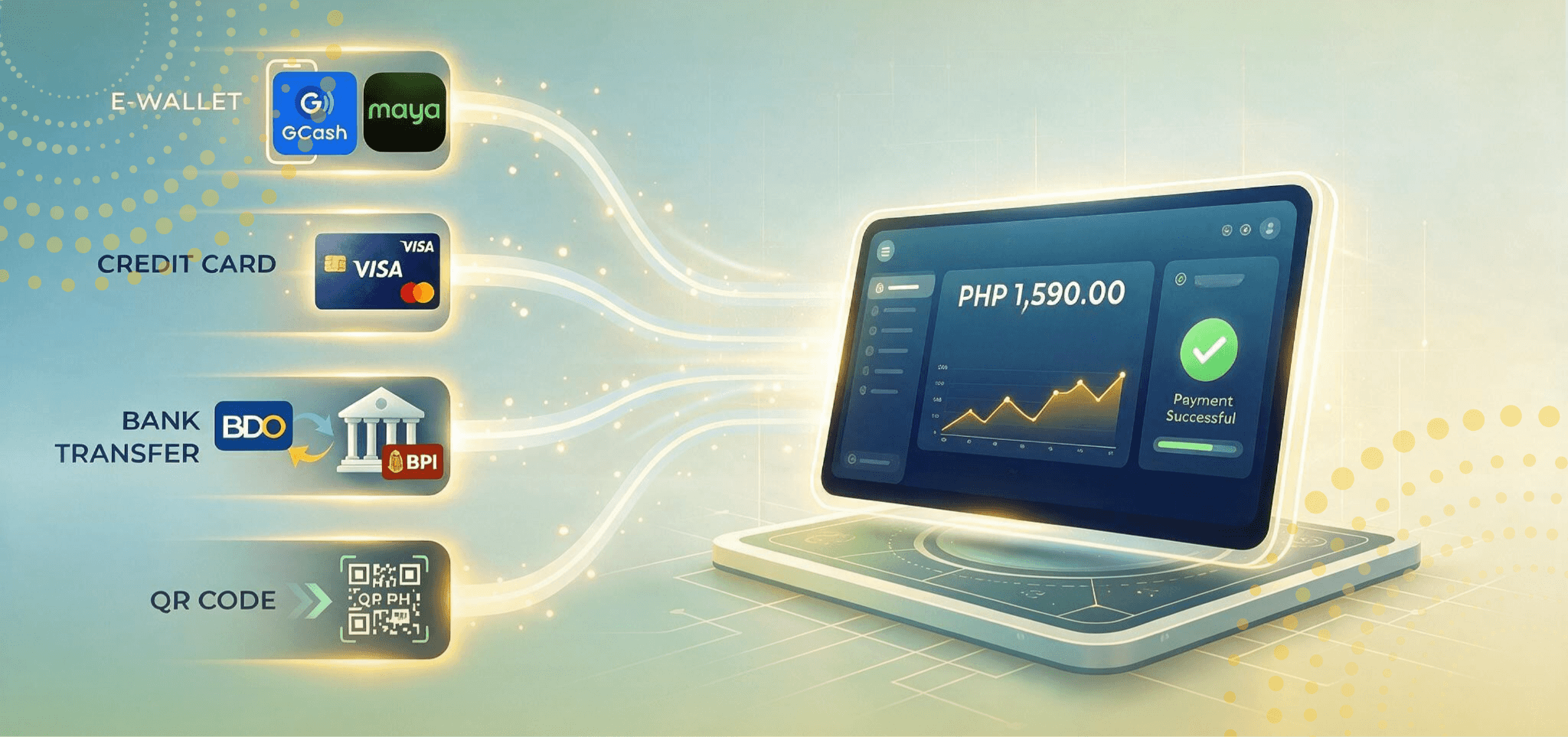
Filipino bill payers have made their preferences clear: a mix of GCash, Maya, debit and credit cards, and direct bank transfers, often switching between them depending on convenience and available balance. Essential service providers and enterprises across the country are already feeling this pressure as customers expect the same digital convenience they get from retail apps and food delivery services. A biller that accepts only one or two payment channels loses on-time payments to competitors that support customers’ preferred payment methods. Meeting people where they already are, rather than asking them to adapt to a limited menu of options, has quietly become the baseline expectation rather than a nice-to-have feature.
One Gateway, 50+ Channels: How Real Consolidation Works
Real consolidation isn’t about adding a second vendor on top of the first. It means routing cards, e-wallets, and bank transfers through one integration, one settlement view, and one support relationship. This is the same logic behind payment orchestration platforms worldwide: connect once, and every new payment method becomes a configuration change instead of a development project. For a high-volume biller, that difference determines whether launching a new channel takes a sprint or a quarter.
This is also where billers can lean on an experienced platform locally: an online payment gateway in the Philippines makes reconciliation happen against a single ledger, support escalations go to one number, and adding a new bank partner or e-wallet doesn’t require touching the biller’s core systems again. Billers making this shift can start with a financial solution from providers like Paynamics’ payment resources to see how consolidated collection works in practice.
Tips for Choosing the Right Payment Gateway for Businesses, Enterprises, and Government Entities in the Philippines
Not every organization needs the same setup. A water district, a private school, and a national agency all collect payments differently, and the right gateway should flex to match transaction volume, billing cycle, and compliance requirements rather than forcing every biller into the same template. A few starting points:
Utility Billers
High transaction volume and strict uptime expectations mean billers need a payment gateway for website integrations that can process transactions at scale alongside over-the-counter and mobile channels, without downtime translating directly into missed collection deadlines.
Essential Services
Insurance agencies, banks, and medical providers serve customers who cannot simply skip a payment cycle, so essential-service billers should prioritize channel breadth and same-day settlement visibility over any single feature, since a missed reconciliation window here has an immediate impact on cash flow.
Schools and Institutions
Schools collect tuition on predictable calendars but often in batches, so institutions benefit most from a gateway that supports bulk collection reporting, parent-facing convenience fees, and clear audit trails for finance offices that answer to boards and regulators rather than shareholders.
Payment Gateway with QRPH
QRPH gives billers a Bangko Sentral-backed, interoperable standard that works across participating banks and e-wallets. Payment platforms today in the Philippines with an online payment gateway that supports QRPH natively remove the need to negotiate separate QR arrangements with each partner institution.
Payment Gateway with Installment Options
Larger billing charges, subscriptions, or mortgage payments are easier to collect when a gateway can split them into manageable installments at checkout, giving customers a way to stay current without falling behind on services they can’t do without.
Paynamics Payment Solutions: One Gateway for Every Payment Channel
This is precisely the gap Paynamics was built to close. As a BSP-supervised Electronic Money Issuer holding PCI DSS v4.0 certification, Paynamics already supports more than 5,000 merchants across over 50 payment channels, giving utility and essential-service billers and other enterprises immediate reach across cards, e-wallets, and bank transfers under a single integration.
For billers managing recurring collections across schools, insurance, real estate associations, or retail locations, the value isn’t just accepting more payment types; it’s all about having one partner responsible for payment acceptance, payouts, and wallet management together. What you need is a payment gateway authority backed by enterprise and government-scale experience. If you’re looking to explore a consolidated setup, visit and review Paynamics’ checkout capabilities and its business wallet tools to understand how collection and disbursement work together under one local online payment gateway in the Philippines that billers can standardize on, rather than stitching together year after year.
Conclusion
Consolidating collection onto one gateway doesn’t just simplify a billing team’s life. It removes the operational drag that a fragmented stack quietly imposes: duplicated reconciliation, inconsistent uptime, and a support experience that varies by provider. For utility, essential-service billers as well as government and enterprise companies, that translates into full channel coverage, regulatory assurance, and a single source of truth for every transaction that comes in.
If your organization is still stitching together separate providers for cards, e-wallets, and bank transfers, it may be worth seeing what a single online payment platform built for this exact problem looks like in practice, and how much of that patchwork it could realistically replace. A biller that accepts only one or two payment channels loses on-time payments to competitors that support customers’ preferred payment methods.
To learn how Paynamics Technologies Inc. can help you consolidate your payment collection into a unified, compliant, and fully channel-covered platform, visit their website for the full rundown on their enterprise payment solutions.