
Introduction
A water district office has customers ready to pay via their phones. School registrars are getting calls from parents asking for a payment link. Some regional distributors still go to branch counters to collect payments via deposit slips. Those billers don’t have a website, a developer, or months to spend on integration. So, when you’re looking for online payment methods in the Philippines, what do you need to get going this month?
The answer is simpler than most people expect. There are three options that require no integration: PTI Pages (a browser-based eBiller), universal QR, and PTI Pages. This article covers each option, then explains reporting and payouts to show the value you get.
Where Philippine Online Payments Stand Today, and What It Means for Billers
Philippine payers have already moved to digital. The BSP reported that digital payments accounted for 64.7% of retail payment volume in 2025 (up from 57.4% in 2024). That year, QR Ph transactions overtook debit and credit card transactions for the first time, with 2.47 billion transactions processed. Digital payment accounts rose 69.4%, and the number of merchant locations accepting digital payments grew 36.3%.
People now expect to pay every bill the same way. If a parent pays for groceries by scanning a code, they’ll want to do the same at school. The issue is on the biller’s side, really, because existing payment systems are built around cash, cheques, and the counter.
Today it’s the norm to offer a mixture of online payment channels (cards, digital wallets, online banking, OTC, QR). No single channel will suit everyone. If you’re a biller and you only offer one channel, you’re going to be missing out on a lot of people.
Going Online Without an E-Commerce Website: PTI Pages and the Browser-Based eBiller
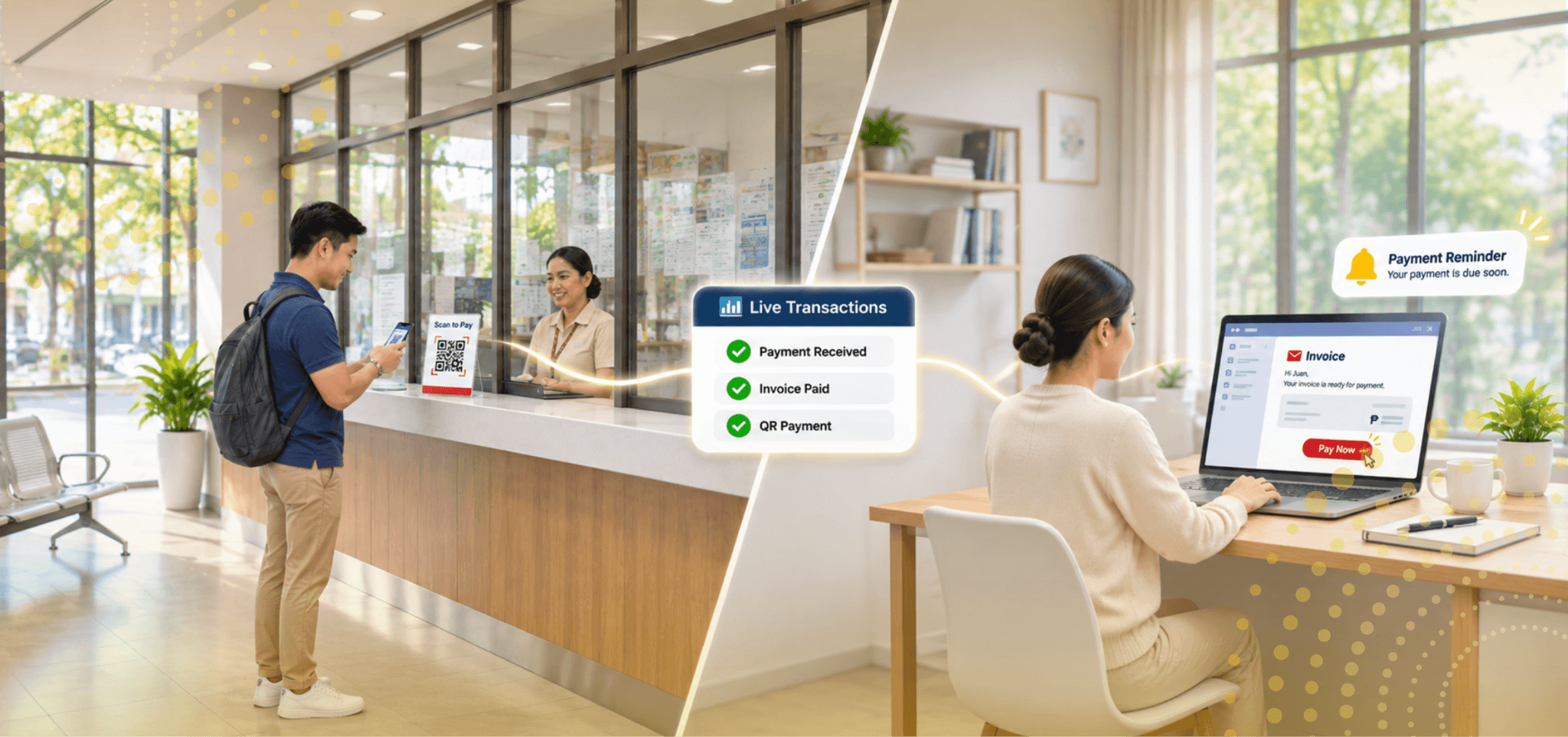
A PTI Page is a hosted payment page that is set up for the biller. The payer simply opens the link, selects a card, digital wallet, or online banking, and pays. The biller doesn’t need API integration, developers, or a website. You can send the link via message, email, social post, or turn it into a QR code to print.
The eBiller works in the browser. It runs in the browser. Staff enter the billing details, and the system sends email invoices and payment reminders to each payer as needed, so the finance team doesn’t have to follow up. Payers can pay directly from the email. That’s the basis of an online payment solution that can go live in days.
The PTI dashboard reports that information. Staff can see what’s been paid, what’s still open, and who’s sent what. No need to reconcile by hand against bank statements. That’s the difference between a tool that just collects money and one that actually closes the books.
Universal QR Code Per Branch, SKU or Campaign
The national QR Ph standard lets a single code accept payments from any participating bank or wallet app, so merchants don’t need a separate code for each provider. QR Ph is for person-to-merchant payments (the merchant pays the transaction fee), while InstaPay QR is for person-to-person transfers. Paynamics takes this a step further by creating a universal QR code for each branch, SKU, and campaign.
Tagging is useful. A single code per school campus tells you what that campus has collected. A code per utility branch shows you results by branch. A code per fundraising drive will track the performance of that individual drive. No extra hardware is required; just print or display the code. Because each payment has its source attached, the dashboard reports are clearer, and reconciliation is faster.
QR is now one of the most widely used online payment methods among Philippine payers, and a tagged code turns that into useful data for the finance team.
Government Offices and Essential-Service Billers: Compliance, Convenience and Reconciliation
The government is moving in the same direction. A 2022 Executive Order directed agencies to use digital payments for disbursements and collections, and a 2025 DILG circular sets the guidelines for electronic online payment methods and collection systems in local government.
Essential service billers take note. Water, electricity, and telecom providers bill many payers on a fixed schedule, and their records must be audit-ready. Using a BSP-supervised provider with PCI DSS v4.0 certification and a track record with the government reduces risk for everyone. Real-time reporting and automated T+1 settlements provide the treasurer with an audit-ready trail from payment to settlement, without the pile of paper.
5 Things to Check Before You Go Live With Online Payments (No Website, No Integration)
Work through this list before the first payer sees a link or a code.
1. Match the channel mix to how your payers already pay
List how payers settle bills today: branch deposits, wallets, cards, bank transfers. The online payment methods you switch on should mirror that list, with room for the channels payers are moving toward.
2. Pick the no-integration tool for each billing situation
Use a PTI Page for general collection, the eBiller for invoiced customers who need reminders, and universal QR codes for walk-in payers and events.
3. Generate a universal QR per branch, SKU, or campaign
Decide on your tagging before anything is printed. The labels you choose now become the filters your finance team relies on later.
4. Confirm your provider’s credentials
Ask for proof of BSP supervision as an Electronic Money Issuer and a current PCI DSS v4.0 certification, then ask about enterprise and government clients. Paynamics can show all of them.
5. Plan reporting and payouts before launch
Agree on who is going to look at the PTI dashboard and how often, and how finance will match the payouts to the reports. Payouts will be automated on a T+1 basis (funds will be in the next business day). Billers with repeat payers can subsequently add in tokenized Auto Charge and Auto Debit enrolment.
Empower Customers and Clients with the Paynamics Business Wallet: Go Online Without a Website
The Paynamics Business Wallet enables billers to accept QR codes and shareable payment links without a website or a POS terminal. A clinic, a travel agency taking booking fees, a cooperative collecting dues, or a barangay office can all get started with nothing more than a wallet and a phone.
The same ecosystem connects PTI Pages, the eBiller, and universal QR codes to real-time dashboard reports and automated T+1 payouts. Acceptance, payouts, and the wallet are all in one place, so collections don’t get dispersed across various platforms. Paynamics is a BSP-supervised Electronic Money Issuer with PCI DSS v4.0 certification and over 5,000 merchants, and that experience shapes the advice we give billers during onboarding.
Conclusion
Billers do not need a website to get paid online. They need the right mix of PTI Pages, eBiller, and universal QR, supported by real-time reporting and T+1 payouts. A team that partners with a reliable online payment method that Philippine payers favor can start collecting well before the quarter ends.
Talk to Paynamics experts about a no-integration go-live, then explore the Business Wallet, Checkout, and the full set of Paynamics solutions.