
Introduction
Month-end is pretty much the same across the board in most finance teams. Bank credits come in batches, invoices are in a separate file, and then you spend a day or two putting it all together. Reconciliation is what stops the cash flow or gets it moving. Enterprise and government teams feel it the most, as the volumes are so large and every channel has its own export file. The answer is not more people. The answer is cleaner data from the very first moment the transaction occurs.
This article explains how Paynamics’ financial reconciliation works and ends with a month-end checklist your team can easily adopt.
Why Manual Reconciliation Slows the Close
Financial reconciliation is all about comparing your internal records against external records (usually bank statements) to ensure they’re in agreement. Payment reconciliation is a narrower form of reconciliation in which each payment is matched to the invoice or order it relates to. The reconciliation process in finance generally involves the collection of data, the matching of that data, investigation of any variances, the making of adjustments, and then sign-off.
Manual matching falls apart when the channels don’t have the same data, the departments record the payments in different ways, and finance only ever sees the revenue at month-end. That’s the exact scenario in public sector teams, where payment reconciliation goes from a ‘review’ to an ‘investigation’. Continuous reconciliation shortens the close as the exceptions surface throughout the month.
The Daily Tribune flagged the same issue for Philippine businesses this year: the gap between how people pay and how the business does its work. The work that comes after the payment is still almost entirely manual (only 18.75% of business payments were digital in 2025). The more channels you have (card, wallet, bank transfer, etc.), the more files finance has to reconcile, so the more you achieve in that respect, the worse the problem becomes. Of course, the government finance teams have the added burden of having to be answerable to auditors and having to trace every receipt from collection to deposit.
Pre-Tagged Transactions: Per-Branch, Per-SKU and Per-Campaign QR Codes and eBiller Invoices
Matching is straightforward when every payment has a label. A dynamic QR Ph code or a payment linked to an invoice has a unique reference, so each payment can be matched to one transaction, one branch, or one campaign. QR Ph is the BSP standard for person-to-merchant payments, so one code will accept payments from many banks and wallets.
With a business wallet, you generate your QR codes and payment links with labels pre-applied. A retail chain can create a code for each store; a marketing team can create a code for each campaign. The same is true of SKU-level codes. eBiller invoices will have the reference of the account that they are settling. A biller with no website and no developers at all can get going with a ready-made checkout page that requires no API integration. A co-op selling annual memberships or a school raising money for a particular purpose can be live without writing a single line of code, and every payment will still have its reference.
Reconciliation Meets T+1: A Faster Collection-to-Cash Cycle
Clean real-time records mean T+1 payouts are predictable. The PTI dashboard will show the day’s collections, and the payout credit will post one business day after the transaction day. That gives finance a chance to match settlements against a report they already have. HitPay describes the same process for the Philippine merchants (T+1 payouts, check the day’s collections in the morning).
This is where Paynamics’ financial reconciliation really shines in the course of normal day-to-day work, as there’s very little to investigate, as the label and the report are already in agreement. Cutoffs, weekends, and holidays still apply. A payment made late on a Friday or on a bank holiday will still be subject to the next working day rule.
Confirm the current Paynamics schedule with the team and get it on your close calendar. For finance teams that close on a fixed date, you’ll need to mark the days when a payout will skip a day and then plan the cut accordingly. A predictable cycle is only useful if you know the calendar.
Reconciliation in Practice: Government, Schools, Real Estate, and Insurance
Recurring payments reconcile perfectly when enrollment is tokenized, and Auto Debit runs online. Property amortizations illustrate this very clearly. BPI and Ayala Land have both launched cross-bank auto debit so that buyers and tenants can pay out of any of the participating banks. Every debit is a debit pursuant to an authorized mandate with a known date. Tuition is the same in that respect, as it’s a parent’s enrollment that gives you a predictable monthly entry.
Any government office operating under EO 170 and providing a digital collection will record every receipt. The Insurance Commission’s circular helps the insurer by recognizing digital payments as part of insurance technology. It allows them to use BIN filtering for targeted campaigns, to test and pre-launch a product with a particular card segment and then go on to trace the results payment by payment. The same is true of the travel operator who is collecting their booking fees through the Paynamics Wallet. In each case, the biller will read one report and the credit that follows will confirm it.
A 7-Step Month-End Close Checklist for Enterprise and Government Billers
Follow these steps every month. Each one carries a short tip, and none needs more than the dashboard and your bank statement.
- Define the scope: List every channel, every branch, and every account that’s in the review so that nothing is outside of it.
- Tag at the source: Label payments when you create the QR code, link, or invoice.
- Pull the day’s PTI dashboard report: Download the real-time report each morning for the previous day.
- Match to T+1 payout credits: Compare that report with the credit in your account.
- Clear exceptions daily: Resolve unmatched items the same day, while the details are fresh.
- Lock the period: Close the period once every item is matched or documented, and note any open item for next month.
- Review collection ratios: Compare collected against billed to see which branches or campaigns lag.
Pre-Tagged, Pre-Reconciled: Paynamics Business Wallet QR Codes and Payment Links
Paynamics Business Wallet creates labeled QR codes and payment links and then brings all your collections (from QR codes, links, and webstores) into one wallet. You’ve got everything on a single dashboard. Checkout provides real-time reporting across 50+ channels, and Payout Solutions (listed on the Solutions page) provide T+1 settlement.
The approach has been proven at scale. Paynamics is an EMI operating under BSP supervision, is PCI DSS v4.0 certified, and serves 5k+ merchants. For the finance team, that translates into real-time visibility on collections and predictable payouts. Branch managers can also have dashboard access so they can answer payment questions at the branch without having to go to head office.
The exact same close process applies across all of the different billing models, as Paynamics also deals with recurring bills and collections for utilities, schools, insurers, and QR Ph retailers.
Conclusion
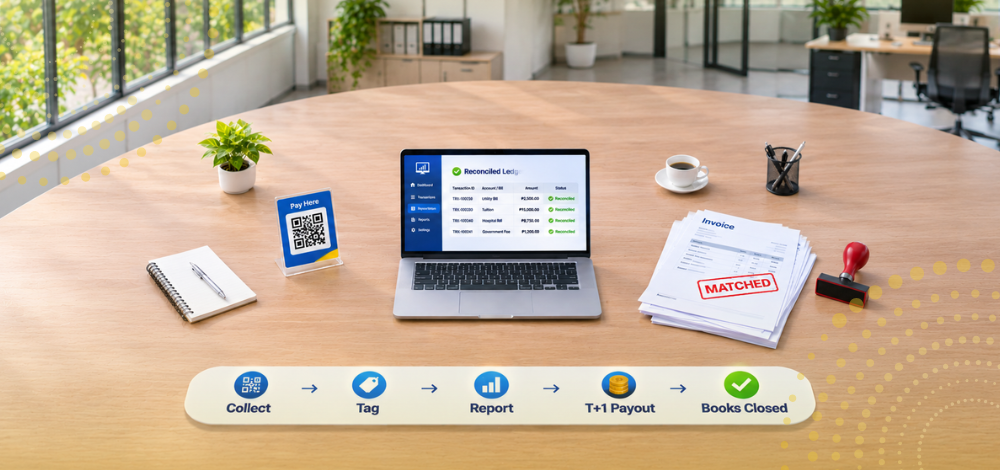
The flow is simple: tag, see, settle. You tag at the source so every payment is visible in the system, the dashboard reflects that in real time, and T+1 payouts get the money in one business day. Finance closes much quicker as there’s far less to chase. That’s the practical benefit of Paynamics’ financial reconciliation. Check out Paynamics’ solutions and request a call with the team.