
Introduction
Search for a simple payment app, and most SME owners quietly expect a trade-off: easy to use, but shallow in what it can actually do. That assumption comes from years of choosing between a complicated developer-built checkout or a bare-bones QR code sticker taped to a counter. Neither option feels complete. A genuinely user-friendly payment app for SMEs in the Philippines does not have to choose between simplicity and capability. A no-code, no-integration setup can generate a payment link or QR code in seconds while still running on the same regulated, secure infrastructure used by much larger businesses. Streamlined e-wallet apps allow you to catch up with your growing business with no line of code, no website, and no compromise required.
The No Code Myth: Why Easy to Use Doesn’t Have to Mean Missing Features
The common assumption is that a simple, no-code payment tool must sacrifice functionality somewhere else, usually in security or in how many payment methods it can accept. That assumption breaks down once you look at what actually runs underneath a no-code interface. A merchant who wants to accept payments without a website does not need a simplified, lesser version of payment infrastructure. The same PCI DSS v4.0 certified backbone used for a full developer integration can sit behind a QR code or a shared link just as easily.
The simplicity SME owners want comes down to one thing: the interface of small business payment solutions. Fewer steps, no technical setup, nothing to configure. And behind that simple interface, acceptance, security, and reporting are just as powerful as any enterprise system because they’re built on the same foundation.
Generate, Share, Get Paid: QR Codes and Digital Invoices Without Touching a Line of Code
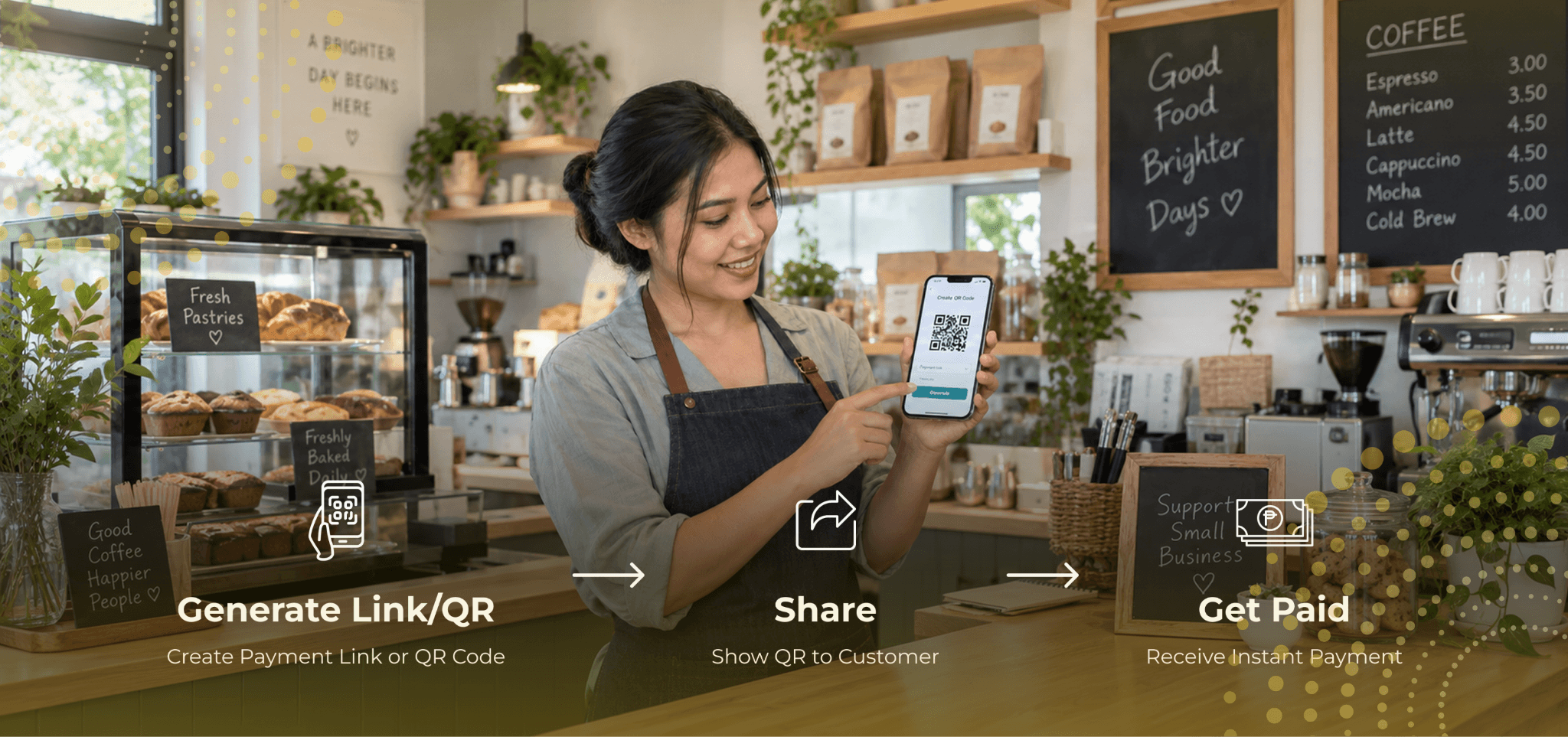
For a business without a developer or a website, the biggest barrier to accepting digital payments has always been technical setup. A no-code setup removes that barrier by letting an owner generate a QR code for a stall or pop-up booth, or send a payment link through Messenger, Viber, or SMS, with no coding and no website involved. A customer taps the link, chooses a payment method, and pays.
No matter how a payment comes in, via a QR code, an invoice, or a shared checkout page, the merchant sees it appear on the same dashboard as every other transaction. That’s what makes online payment platforms for small businesses a true no-code setup: what used to require a call with a developer is now something an owner can set up alone in under a minute, even between customers.
The Power Underneath the Simplicity: Real-Time Reconciliation on the PTI Dashboard
A genuinely simple front end can still give an SME owner enterprise-level visibility into their money, through a real-time transactions dashboard that reconciles payments as they happen rather than at the end of the day or week. This matters more for a no-code merchant than for one with a full developer integration because it is often the owner who does the manual checking between customers to see if a specific payment actually came through. Real-time reporting replaces that manual checking with a live view: every transaction, its status, and its channel, visible on one screen. This is how even a first-time user gets the most out of the dashboard to track daily collections without exporting or manually matching a single row.
Secure by Default: How PCI DSS v4.0 Tokenization Protects a No-Code Merchant’s Customers
Security for a no-code merchant is handled automatically, not configured manually, and that distinction is what makes the setup genuinely simple rather than simple with a hidden risk attached. PCI DSS v4.0-aligned tokenization protects card data without requiring the business owner to set up or manage any of it themselves. This matters for customer trust in a very direct way, since the business does not need technical expertise to offer bank-grade protection because the protection is built into the platform itself.
For online payment platforms for small businesses, the assumption is that security has to be self-managed; this is the opposite case. The merchant benefits from a user-friendly payment app for SMEs in the Philippines with the same protection a much larger, fully integrated business relies on without ever touching a security setting or reading a compliance document.
5 Things You Can Do in a No-Code Payment App Without Writing a Single Line of Code
These five things show exactly how far a user-friendly payment app for SMEs in the Philippines can go without a single line of code:
- Generate a QR code for a physical stall, pop-up booth, or storefront, ready to accept payment in under a minute.
- Send a digital payment link through Messenger, Viber, or SMS for an order, with no website involved at any point.
- Accept payment across channels: Cards, e-wallets, and bank transfers, all through a single shared link the customer taps once.
- Check if a payment is settled in real time, from the same dashboard used for every other transaction the business runs.
- Track daily collections without exporting or manually matching a single spreadsheet row against a bank statement.
Paynamics Business Wallet: Your Simplest Path to Digital Payments
No website, no developer, no problem. The Paynamics Business Wallet lets an SME generate a QR code or payment link in seconds, while running on BSP-supervised, PCI DSS v4.0-certified infrastructure with real-time reconciliation and T+1 payouts underneath. It works for e-wallet app users just starting out and for established retailers, schools, insurers, and travel operators alike, all through the same simple interface. The complexity stays where it belongs, inside the platform, so the merchant only ever has to generate a link, share it, and get paid.
Conclusion
A simple app for an SME without a website or technical team does not have to mean a stripped-down one. A genuine user-friendly payment app for SMEs in the Philippines can still deliver the same regulated security, broad channel coverage, and real-time visibility that larger, fully integrated merchants rely on every day. The only difference is how little setup it takes to get there.
If chasing payment confirmations across apps and screenshots has become part of your daily routine, it may be time to see what Paynamics no-code Business Wallet can do instead.