Introduction
Filipinos are paying digitally more than ever, yet many households still go to the counter to pay their water bill or hand over post-dated checks for tuition. That’s where digital financial inclusion in the Philippines becomes a very practical question for billers. The banks and wallets have opened the door. Billers decide how many people actually walk through that door on the due date, and that’s the real test of digital financial inclusion.
This guide shows how utilities, schools, developers, insurers, and government offices can take on more payers and still get their money. Paynamics has built its toolset around that very issue.
Where Digital Financial Inclusion Stands in the Philippines and What It Means for Billers
The BSP’s 2025 Consumer Finance and Inclusion Survey shows adult account ownership at 50% (down from 56% in 2021). Household access is quite different: 85% of households have at least one account, so many households share access. Electronic money is the main driver of account ownership.
Payments data point to the same. Digital payments made up 64.7% of retail payment volume in 2025, up from 57.4% a year earlier. Business payments lag far behind, at only 18.75% digital, which is why finance teams feel the strain once the customer has paid.
For the biller, digital financial services and financial inclusion means more than just access to clear an invoice. A household may have a wallet and still miss a due date if the only way to pay is to go to the branch, do a manual transfer, or use a card the payer doesn’t have. On-time collection depends on how the payment is set up.
Auto-Debit Enrollment as the Next Step in Biller-Led Inclusion
For a long time, auto-debit worked only when the payer and the biller banked with the same bank (effectively excluding the vast majority of households). On July 29, 2026, the BSP and Philippine Payments Management Inc. launched Direct Debit PH, an interoperable rail that enables a consumer to authorize a biller to collect from a bank or e-money account on a set date. The consumer pays nothing, the biller pays the transaction cost, and the payer can cancel the mandate at any time.
Tokenization under the PCI DSS v4.0 certification enables payers to enroll online for Auto Charge and Auto Debit arrangements. The payer authorizes once, and a token replaces the card number on all subsequent charges. Collection ratios rose for the billers that adopted this workflow, and other merchants have since followed the same route.
For a household far from a branch, enrollment on a phone changes the picture. For the biller, a due date no longer depends on a reminder text.
Beyond Cards: Non-Card Installments That Widen Who Can Pay
Not everyone has a credit card, but that shouldn’t stop them from paying for important expenses in manageable amounts. In the Philippines, an estimated 76% of the population is unbanked or underserved. This creates an opportunity for cardless installment services like BillEase.
With BillEase, customers can choose a payment option that fits their budget. They can pay after 10 or 20 days, split purchases into four installments, or spread larger payments over three to 12 months.
Banks also provide installment plans via providers such as BDO and BPI (depending on the biller’s payment channels). This makes things like tuition and annual insurance premiums much easier to deal with, as you can pay smaller amounts over time.
This is how digital banking and financial inclusion make a difference in the day-to-day payments we all make. A biller can offer more ways to pay and reach customers who may not have a credit card, while still receiving payment through a regulated financial channel.
Inclusion Without Cash-Flow Risk: Real-Time Reports and T+1 Payouts
Finance teams often worry that more payment options, installments, and recurring mandates mean more money to track and match. That worry is solvable. Here’s what to look for:
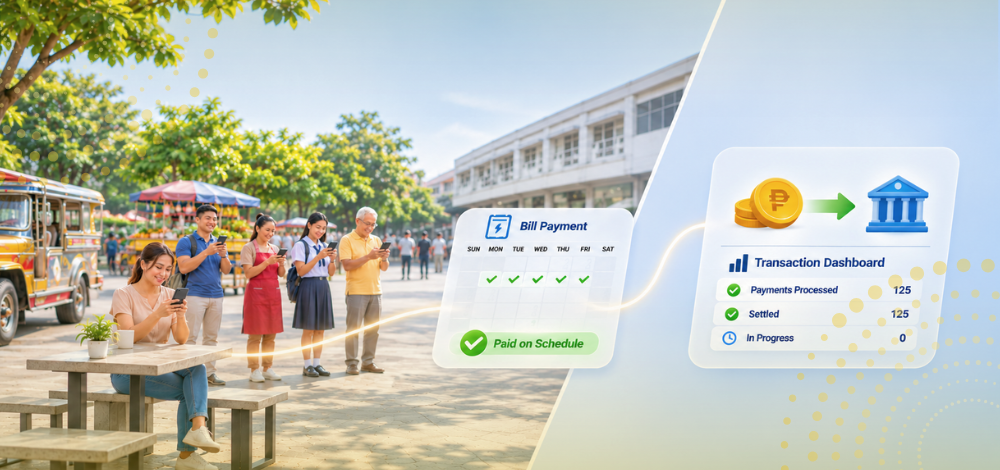
- Real-Time Reporting. A live dashboard that records every enrollment, every installment, and every recurring charge as it happens means you no longer have to export the files and then go through and manually match the rows. Finance can confirm a payment in seconds.
- T+1 Payouts. Funds arrive one business day after the transaction date, automatically. Predictable timing makes forecasting easier and shrinks the reconciliation window to a single day.
- Automatic Reconciliation. Unique reference numbers and settlement reports that show which transactions each payout covers turn matching into a quick check instead of a monthly project.
- Tokenization. Instead of storing real card numbers, the system keeps a random substitute called a token. The PCI Security Standards Council notes this reduces the chances of card numbers being exposed. Look for providers with current PCI DSS v4.0 compliance.
The takeaway: Flexible payment options open the door to more people, and the right tools let billers keep clear sight of every peso. Payers get convenience, and billers get certainty.
6 Ways Essential-Service Billers Can Widen Access and Keep Payers on Schedule
Together, those moves illustrate what digital financial inclusion in the Philippines looks like at the billing desk.
1. Online Auto-Debit Enrollment for Utilities and Tuition
A water district or school sends an enrollment link, and the payer authorizes recurring charges once on their phone. A subdivision can collect its HOA dues the same way.
2. Installment Options for Large Bills
A parent splits a semester balance into monthly parts, and the school sees each payment on the dashboard the same day.
3. QR Codes and Payment Links Through Business Wallet
A store with multiple branches will have one Business Wallet QR code per branch. An agent with no website will send a payment link in chat. Billers with no developers can use a ready-made checkout page that requires no API integration.
4. Digital Collection Mandates for Government Billers
Executive Order 170 directs covered agencies to offer a digital way to pay taxes, fees, and other charges. Paynamics’ enterprise and government experience has a ready starting point.
5. Recurring Premium Collection for Insurers
An insurer stores a token at enrollment and charges each premium on its due date through click-to-pay, in step with the Insurance Commission’s push for digital payments.
6. BIN Filtering To Run Exclusive Campaigns
A BIN is the first four to six digits of a card and identifies its issuer, so an insurer can open a pre-launch offer to one bank’s cardholders and read the results cleanly.
Paynamics Payout Solutions: T+1 Settlement That Protects Your Cash Flow
Managing collections across multiple payment channels can be challenging, especially when businesses need to track payments and maintain a healthy cash flow. Paynamics makes this easier with flexible collection channels and automated T+1 settlements, helping businesses receive their funds more predictably.
Through Paynamics Checkout, billers can accept payments through more than 50 payment channels. For businesses without an online store, Paynamics Business Wallet offers additional collection options through store QR codes and payment links. Both solutions support automated payouts, with transactions credited to the business the next business day.
These are solutions that work across all industries. Paynamics is a BSP-supervised EMI with PCI DSS v4.0 compliance and over 5,000 merchant clients, making it a solid partner for businesses looking to manage their digital collections.
Conclusion
Inclusion, tokenized enrolment, cardless installments and T+1 payouts all work as one system. More people have ways to pay that fit their income, and finance teams have records that match what actually hits the bank. That’s what digital financial inclusion in the Philippines looks like when the billers have actually built it in.
To see how this would fit in with your collections, have a look at Paynamics’ solutions and get in touch with the Paynamics team.