Introduction
A shopper puts a fridge, a laptop, or a semester of tuition in their cart and checks the total before walking away. Checkout is card only. No installments, no wallet, no alternative. The merchant sees an abandoned cart in the morning and, a week later, a different issue: payments coming in from five channels on five different schedules and a finance team that has to manually match them. The e-commerce payment process has a front end that converts and a back end that reconciles, and weakness in either area costs money.
Merchants looking for a payment method for e-commerce shoppers in the Philippines face a long list of options. The real question is which of those actually get you conversion on the more expensive, more recurring purchases and how the reports in that space are going to be clean.
How Filipino Shoppers Pay Online in 2026
Filipino consumers are now utilizing a range of payment methods. Digital wallets are used for the bulk of their day-to-day spending. Bank-based payments are the standard for larger purchases. Credit and debit cards are still very much in use for big purchases. Cash on delivery remains an option for those who want to see what they’re buying before paying. Buy now, pay later is also on the rise.
According to IDC projections reported by BusinessWorld, mobile wallets and e-payments will remain the main driver of e-commerce growth. The BSP reported that digital payments accounted for 64.7% of retail transaction volume in 2025.
For merchants, offering just one or two payment options can mean losing potential sales. For example:
- Digital wallets: Appeal to shoppers who want a quick, easy checkout.
- Bank transfers and online banking: The way to go for customers making a larger payment.
- Cards: Give the buyer access to high-value purchases and installment plans.
- Cash on delivery: Builds confidence for shoppers who want to pay on receipt.
- BNPL: Makes bigger purchases more manageable through flexible payments.
The more payment options you have, the fewer reasons people will have to abandon their cart. A good provider for e-commerce payment methods in the Philippines offers a range of payment options and is mobile-friendly. Shoppers get a smooth checkout, and merchants can add a new payment option without rebuilding their entire checkout.
Understanding customer behavior helps merchants decide which e-commerce payment method to promote. It helps reduce checkout friction, improve conversion rates, and decide which payment method to make most visible.
Installments and BNPL for High-Ticket and Recurring Payers
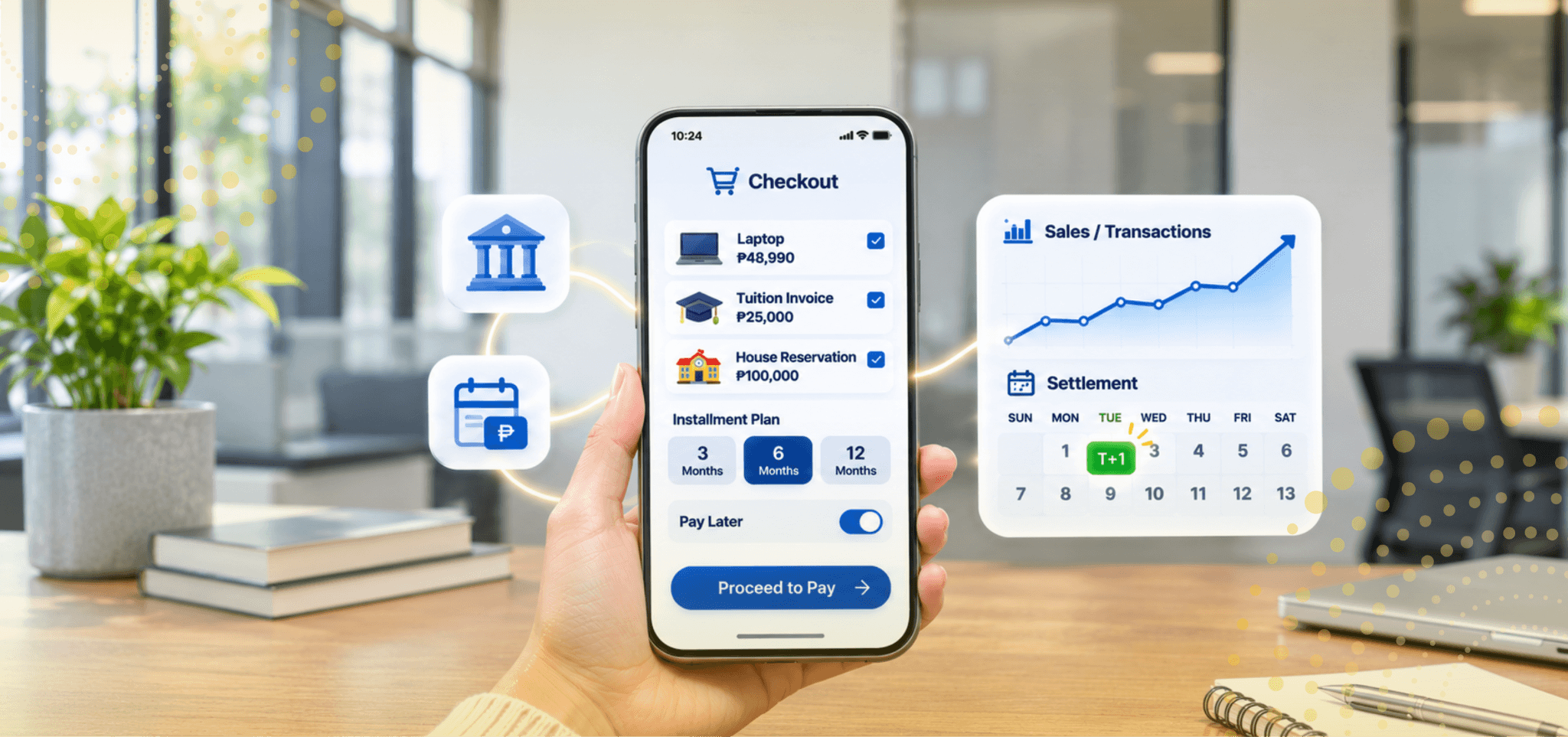
For retailers, schools, and property developers, installments and BNPL can be a real tool for getting hesitant customers to pay. The big barrier to a high-value purchase is usually the initial outlay. Flexible payment options can go a long way toward making the purchase happen.
There are two key options:
- Card installments: Allow the cardholder to spread the cost of their purchases over monthly installments via their issuing bank (including BDO and BPI as partners).
- Non-card BNPL: Providers such as BillEase give cardless shoppers access to flexible payment plans.
This provides both options, enabling merchants to reach a wider customer base (particularly in a market where credit card ownership is still quite low).
Merchants can also target their promotions via BIN filtering. They can identify cards issued by a particular bank and then create offers specifically for those cards.
Beyond the initial purchase, recurring payment features allow the merchant to collect installments on time.
Tokenized Auto Charge and Auto Debit will handle payments once a payment plan is set up. That means the merchant won’t have to chase the customer, and repayment is far more convenient for them.
Choosing a digital mode of payment in e-commerce is about more than the checkout experience. You also need solutions that enable reliable collections right through the payment cycle.
BNPL providers in the Philippines face increasing regulatory scrutiny, so merchants should work with payment partners that comply with relevant regulatory and industry standards.
Unified Reporting: Clearing the Reconciliation Backlog with the Real-Time PTI Dashboard
Accepting more payment methods will boost your sales, but it will also make your financial reporting a lot more complicated. Cards, installments, BNPL providers, digital wallets, and online banking all have different settlement and reporting cycles.
Without centralized reporting, finance teams often have to reconcile multiple statements manually. This can lead to:
- Delayed financial closing
- Unexplained payment discrepancies
- Time-consuming spreadsheet matching
- Limited visibility into pending and failed transactions
For merchants looking to expand their e-commerce payment methods in the Philippines, having a single reporting system is absolutely vital to keeping the books in order.
A real-time PTI dashboard that pulls together the transaction data across all the supported payment channels is the answer to this. It makes payment tracking far easier, speeds up reconciliation, and gives the teams far more time to do the financial analysis rather than just the manual recording. Having real-time transaction visibility allows the teams to monitor the payments coming in whilst the orders are still being processed.
Automated T+1 Payouts: Clean, Fast Settlement
T+1 settlement means the merchants are paid the next business day. The faster and more predictable the payout, the better it is for working capital (i.e., you can go out and pay your suppliers and get ready for the next round of expenses).
Delayed or inconsistent settlement times can force merchants to hold larger cash reserves, which in turn limits the cash available for day-to-day operations and growth.
An automated payout process with T+1 settlement and full reporting lets merchants trace payouts back to the relevant transactions.
Different businesses benefit in different ways:
- Retailers can top up stock much faster and respond more quickly to customer demand.
- Schools can have greater confidence managing payroll and operating expenses with a steady inflow of funds.
- Property developers can track reservation fees and down payments to support project cash flow.
Beyond just faster access to funds, predictable settlement makes financial planning far easier. Clean, predictable settlement gives businesses much better control over their cash flow. It’s not just about getting the money faster; it’s about having the financial visibility and flexibility to plan.
5 Ways Installments and BNPL Lift Online Conversion
1. Lowering the barrier on high-ticket items
A cart worth fifty thousand pesos looks very different on a monthly basis. Card installments through banks like BDO and BPI let consumers commit in smaller steps. A purchase that would have been out of the question becomes a decision that can be made in minutes.
2. Growing average order value
Shoppers who can split their payment often add accessories, warranties, and a higher model. Paynamics offers extensive installment coverage at checkout (the split payment option is right next to the pay button), so you see a bigger basket because of the lower monthly amount.
3. Reaching shoppers without credit cards
BNPL via BillEase brings in the buyer who has no card at all (the card-only checkout can’t cater to that group). Paynamics has BNPL in with the cards, so it’s all one consistent offering for that buyer type, with the same dashboard report under each.
4. Making tuition and school fees manageable
Families can spread tuition costs over the terms, and schools receive payments regularly with far fewer reminders. Parents have a clear view of the schedule, and the registrar sees each payment as it comes in.
5. Easing property reservation and down payments
Developers can take the reservation fee online and then split the down payment into small chunks. There are tokenized recurring options for the months after that. Buyers can commit earlier because the first payment is something they can afford.
Reporting and payouts are exactly the same regardless of which option the buyer chooses, as every transaction ends up on the same PTI dashboard and settles on the same T+1 schedule.
Make Payments Seamless, Settle Faster: Paynamics Checkout with Installments, BNPL and Automated T+1 Payouts
Paynamics Checkout brings together 50+ payment channels, broad card and non-card installment and BNPL coverage, real-time PTI dashboard reporting, and automated T+1 payouts. Shoppers have flexible ways to pay. Finance has one clean view, and funds get in on the T+1.
Merchants with no developers and no webstore can use ready-made payment pages that require no API integration at all. That’s ideal for merchants who run their business via social media and messaging apps. Paynamics Business Wallet also supports QR codes and payment links for the type of collections we see with travel booking fees. The platform is BSP-supervised, PCI DSS v4.0 certified, and has over 5,000 merchants on board.
Conclusion
The ideal payment methods for e-commerce in the Philippines offer flexible installments and BNPL at checkout, with the back end providing unified reporting and T+1 payouts. Shoppers complete more purchases, and the finance teams can close the month with no backlog.
Retailers, schools, and property developers can get in touch with Paynamics experts and then explore Paynamics Checkout, the Business Wallet, and solutions.