
Introduction
The Philippines has embraced the digital economy age. Digital payments accounted for 64.7% of retail volume in 2025, so billers are collecting more via digital channels than ever. Many still reconcile by hand and will chase failed charges by phone. If customers are happy to pay digitally, why do so many collections still fail? And what should a gateway do about that?
Many discussions about payment gateway benefits focus only on secure checkout. But technology does much more. An online payment gateway also affects how many scheduled payments are actually collected. Paynamics, a BSP-supervised Electronic Money Issuer that is PCI DSS v4.0 certified and serves over 5,000 merchants, designs its gateway with this in mind. The next sections explain where collections fail, which features help prevent it, and how real-time reporting and T+1 payouts complete the process.
Why Collections Fail: The Hidden Cost of Manual Reconciliation
Collections often fail for the most fundamental reasons. Cards expire or are declined. Due dates pass, and no one sends the reminder. A payer may well send the correct amount but the wrong reference, which then forces the finance team to spend hours matching bank statements to invoices in spreadsheets. Each of those fixes takes staff time, and as the volume increases, so does the cost of payment.
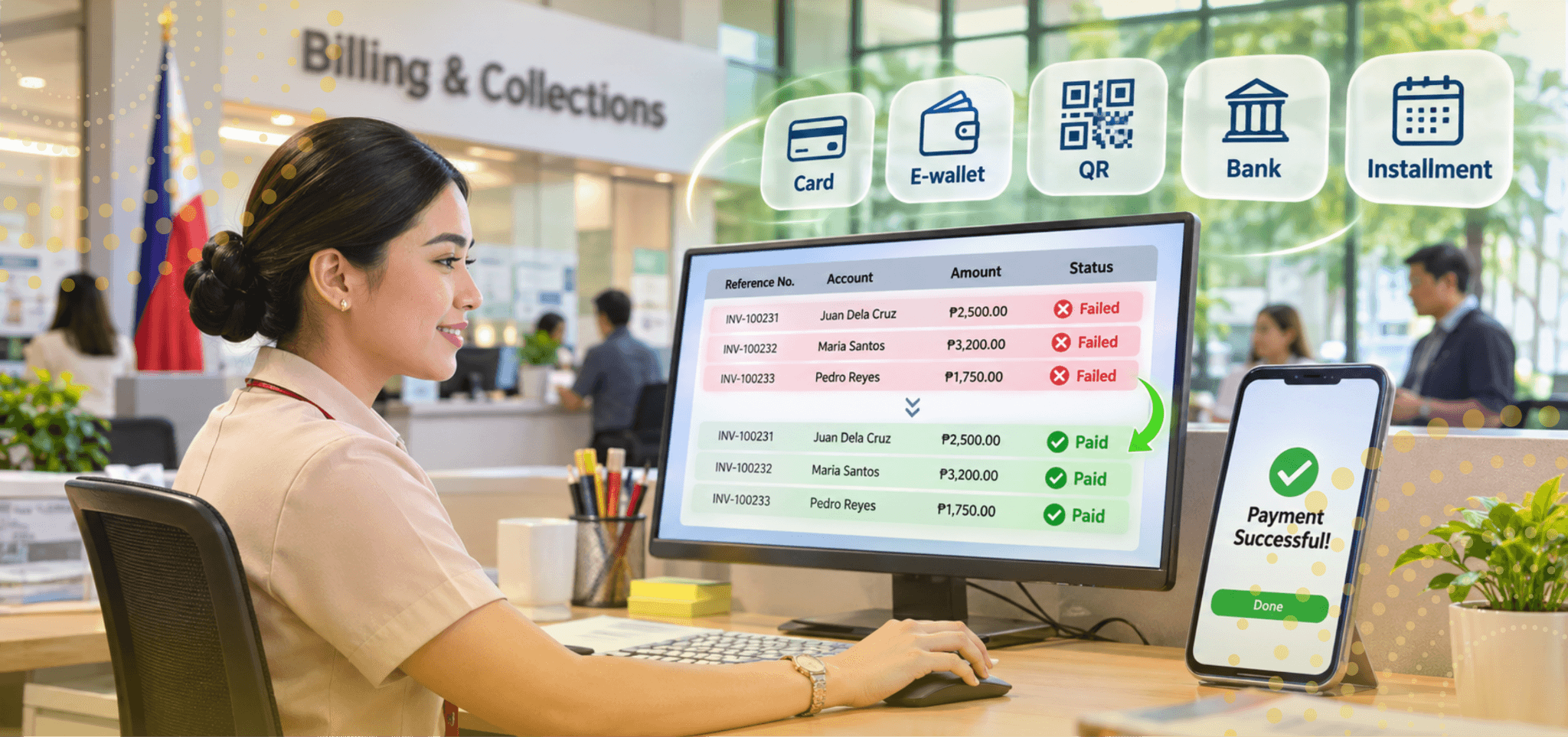
Eliminate the drudgery of manual reconciliation with real-time transaction reports on the PTI dashboard. Any organization that has a bill to collect (schools, utilities, insurers, property billers, etc.) can see what’s been collected, what’s failed, and what’s still pending as it happens. This is by far the biggest time saver, as the report is the working record and you don’t have to re-create it later.
Labor is a hidden cost. Delayed reconciliation also means slower follow-up on failed payments. A payment that’s been sitting for two weeks is much harder to recover than one you’ve got in your pocket and can deal with straight away. Visibility lets you turn a failed payment into a quick call or an automatic retry instead of a write-off. Billers also get a clear picture of which payer groups are failing and can send the right reminders.
Tokenization for Auto-Charge and Auto-Debit: Fewer Missed Payments, Higher Collection Ratios
With PCI DSS v4.0-certified tokenization, customers can sign up online for Auto Charge (ACA) and Auto Debit (ADA). Their card details are stored as secure tokens rather than as raw card data. Once the customer gives consent, they can be charged on schedule without having to remember due dates. Paynamics has seen this process improve collection rates, and other merchants have started using it as well.
The BSP is going down the same route. Their Direct Debit PH service (launched July 2026) enables customers to authorize billers to draw from their bank accounts on pre-agreed dates with a range of participating banks. Scheduled, automatic collection is the new thing, and having a gateway that supports it is a massive advantage for the biller. Insurers, schools, property developers, and utilities can get customers on board online and expand their payment options as more banks join up, without having to re-enroll the customer each time.
Multi-Channel Checkout, BIN Filtering, and Installments That Customers Actually Complete
Having more than 50 payment channels in a single checkout reduces abandonment because customers can pay the way they want. You’ve got cards, digital wallets, online banking, OTC, QR codes, and all the rest of it in one place.
BIN filtering gives you more control. By using BIN filtering to run targeted card campaigns, insurers can test and pre-launch an insurance product with a specific cohort of cardholders. Installments are the final piece. Both card and non-card installments work exactly like online BNPL for large bills (premiums, tuition, property, etc.) that a lot of people simply can’t pay all at once. They allow you to turn a lost sale into a scheduled payment. All the options feed into the same dashboard, so the finance team doesn’t have to do any matching.
Enterprise-Grade Infrastructure and T+1 Payouts: Cash Flow You Can Plan Around
A gateway is only as good as the institution behind it. A reliable and compliant e-money issuer (BSP-supervised), PCI DSS v4.0 certified, with over 5000 merchants and enterprise/government clients matters when choosing a payment gateway provider. The BSP has tightened e-money rules in recent years with increased prudential and capital requirements, helping billers determine who is built to last.
Choose a provider with the latest payout automation that supports T+1 payouts, so funds from successful collections reach the biller the next business day. The faster the settlement, the better the working capital, as incoming money is available to pay suppliers sooner. Acceptance, payouts, and the wallet ecosystem work as one integrated system, so billers don’t have to piece together disparate tools. It’s a fully connected system that turns reliable collections into predictable cash flow.
7 Payment Gateway Benefits for Enterprise Billers Who Want Predictable Collections
Here are the benefits of payment gateway tools enterprise billers can expect when built for recurring bills.
1. Fewer Failed Payments Through Tokenized Auto-Charge/Auto-Debit
Enroll once and charge on schedule. Expired details and forgotten due dates stop being the main reason payments go missing.
2. Real-Time Reporting on the PTI Dashboard Instead of Manual Reconciliation
Every payment attempt is visible in real time. The finance team can see the status right away and handle exceptions the same day.
3. 50+ Channels at One Checkout
Payers can choose from cards, wallets, banks, counters, or QR codes, so abandonment is very low. If one method doesn’t work, they can just pick another.
4. Card and Non-Card Installments for Large Bills
Premiums, tuition, and property payments become plans payers can finish. One benefit of an online payment gateway is that it boosts completion on the biggest invoices.
5. BIN-Filtered Campaigns for Targeted Promos and Product Pre-Launches
Restrict an offer to selected issuing banks, or pre-launch a product with a chosen cardholder group. An insurer can test demand before a wider release.
6. PCI DSS v4.0 Security and BSP Supervision
Certified tokenization and regulator oversight give finance heads something solid to show auditors, and fewer systems hold card data in the first place.
7. T+1 Payout Automation for Steadier Cash Flow
Collected funds arrive the next business day, with an attached report trail so that treasury can plan payments to suppliers and staff.
From Checkout to Payout: Close the Collection Loop with Paynamics
Paynamics Checkout brings together over 50 channels, installments, PCI DSS v4.0 tokenization, BIN filtering, and the PTI dashboard reporting. Both Payouts and the Business Wallet support QR codes and payment links (including for travel booking fees). For businesses without a website or developers, ready-made payments are available without API integration.
With enterprise and government experience behind it, Paynamics speaks as a subject-matter authority on recurring bills and collections for utilities, schools, insurers, real estate, and QRPH, drawing on daily work with its merchants. Advice built on daily practice tends to hold up when it meets a real billing calendar.
Conclusion
The advantages of a payment gateway are making collections reliable. This means tokenization for scheduled charges, channel choice, compliance, real-time visibility, and T+1 payouts. Billers who judge a gateway by that standard will see the benefits of payment gateway tools show up in their collection ratios.
Explore Paynamics Checkout, talk to a Paynamics expert, and look through their full suite of solutions.